Automotive and EV Buildings in New Mexico
A Tesla service and delivery center went up on leased Santa Ana Pueblo land next to Bernalillo and opened in 2023. That one building says most of what automotive and EV work looks like in New Mexico. It is not a giant assembly hall. It is a service floor, a delivery lot, a battery of chargers and a shop that has to stay open while cars come and go. We build that class of building: a rigid frame, insulated walls, a slab poured for lifts and floor trenches, and roll-up doors sized for the vehicles that will use them.
The work under this heading is usually smaller than people expect. It means battery pack and charging equipment assembly, fleet conversion and maintenance bays, dealership service additions, body shops, parts depots and delivery staging. Many of these owners run fleets or franchises rather than factories, so we talk to them as automotive and fleet operators first and as plant owners second. Where a client does need production space, the same frame becomes a lighter version of a manufacturing plant.
One thing we say up front: the electrical service for fast chargers or an assembly line can take longer to get from the utility than the building takes to erect. We plan the steel around that wait, and we tell you plainly when a site is far enough from the metro areas that travel time and construction water change the price.
Where vehicle work lands in the state
Vehicle logistics in New Mexico follows the border and the interstates. The Union Pacific Santa Teresa intermodal terminal lists 74,000 feet of trackage expandable to 145,000 feet and 1,266 container and trailer stalls expandable to 4,380, with a $500 million-plus investment behind it. Parts, batteries and finished goods that cross at the port of entry have to sit somewhere, and that is why Santa Teresa keeps drawing truck terminals and cross-docks and staging buildings.
In Las Cruces, the Innovation and Industrial Park sits at the junction of I-10 and I-25 and the state announced a 45,050 square foot existing building on 15 acres there will be renovated for a new employer. Renovation of existing steel is a real piece of this market. Back in Albuquerque, CBRE describes industrial vacancy as low by historical standards with no new supply added, which pushes smaller operators toward building their own shop instead of waiting for a lease to come open.
What an EV bay needs that a plain shop does not
Start with the floor. A lift bay needs a thickened or reinforced slab where the posts land, and a charging row needs conduit and trench set before the pour, not cut in afterward. We lay out the conduit sleeves with your electrician and pour in one sequence so the trenches are clean. Battery handling adds spill containment, floor drains with the right traps and a clear plan for where damaged packs are quarantined, which your insurer and the fire marshal will both want to see.
Next, the envelope. Service work generates heat and fumes, so we size ventilation and make-up air early, then set eave height for the tallest lift plus the tallest vehicle with its roof rack. High-desert wind loads the long walls of a clear building hard, and a monsoon downpour tests every roof drain, so we draw the roof slope and downspouts for the heaviest storm, not the average one. If a bay opens onto the weather, we flash the door heads like a window, not like an afterthought.
Permits, fire protection and the electrical queue
New Mexico enforces the 2021 New Mexico Commercial Building Code, which adopts the 2021 International Building Code as amended and took effect July 14, 2023. The 2020 New Mexico Electrical Code adopts the 2020 National Electrical Code and has been the only path for permits since September 28, 2023. A charger bank or a battery line is an electrical job first, so we bring your electrical engineer to the table before the frame is ordered.
Fire protection depends on what is stored. A showroom and service floor is one thing. Racks of lithium packs are another, and the sprinkler design, spacing and fire separation come from your engineer and the authority having jurisdiction, not from us guessing. We coordinate with that engineer early, because a late sprinkler change moves purlins, hangers and sometimes the whole roof deck.
What we coordinate with trade partners
We pour the footings, slab and apron, set the anchor bolts to the frame drawings and erect the rigid frame through trade partners. That keeps one crew accountable for a building that has to hold equipment tolerances. A lift post that lands an inch off its reinforcing is a problem you only discover after the cure, and we would rather catch it with a string line the day before the pour.
We also hang the insulated panels, trim the doors and flash the openings, so the first rainstorm does not find a gap between trades. Remote sites are the exception: where the nearest ready-mix plant or water source is a long haul, we say so in the proposal and price the haul instead of burying it in an allowance.
Services that usually go with it
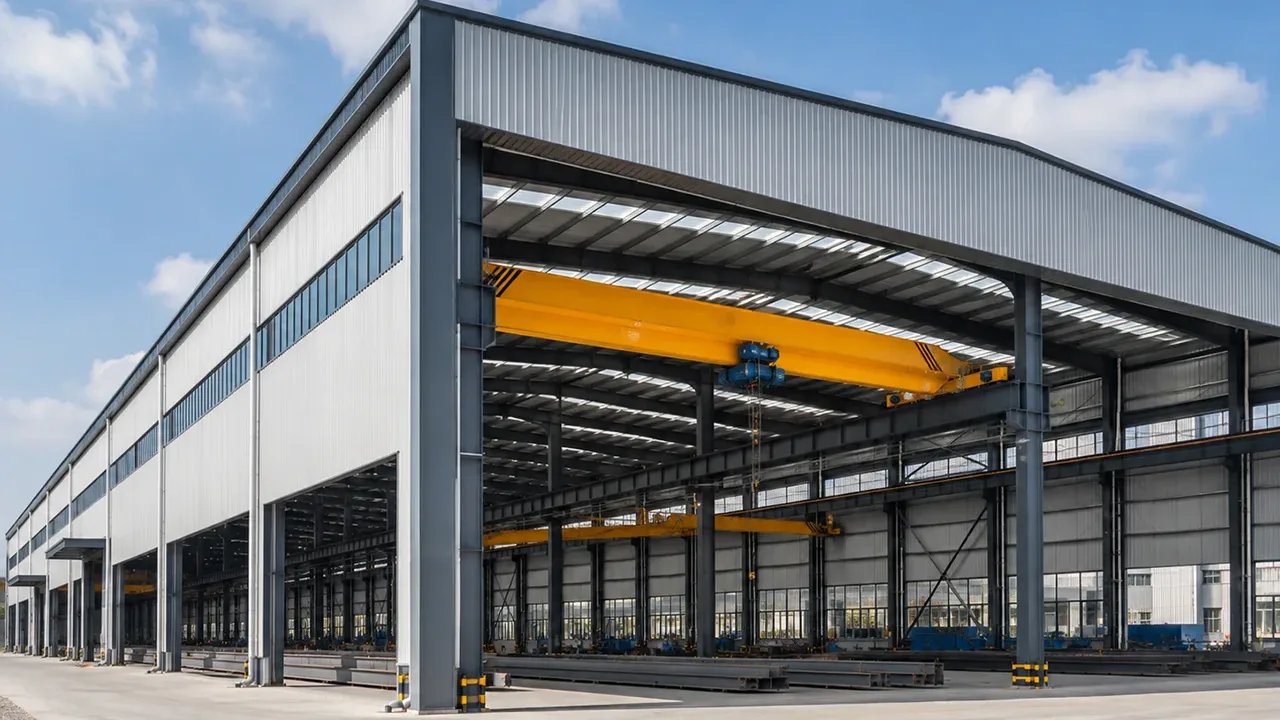
Most vehicle buildings combine three pieces. A crane-ready industrial frame handles pack lifts and engine-out work. Insulated metal panels hold temperature in a shop that opens its doors all day. And a proper foundation, covered in our work on anchor bolts and foundations, keeps the building level when the soil under it moves.
Plenty of owners start with a fleet barn and add a charging canopy or a wash bay in year two. We frame for that growth, leaving a bay line open for an expansion so you are not tearing out the end wall to add on.
Plan your vehicle building with us
Send us the vehicle count, the lift and charger plan and the site address. We will tell you what the frame, slab and utilities look like, and how travel affects mobilization.
Common Questions
Can you build a full EV assembly plant in New Mexico?
We build the structure and envelope of production space, including clear-span bays, crane runways and insulated walls. We do not supply the process equipment, the utility upgrade or the environmental permits, and those usually set the schedule. The best use of a metal building at that scale is a phased plant: erect the first bay, run it, then add bays down a planned expansion line. Tell us the production sequence and we will frame to it.
How much does it cost to build a charging and service shop compared with a plain garage?
Expect the slab and electrical rough-in to cost noticeably more per square foot than a plain garage, because of thickened pads, trenches, drains and conduit. The frame and panels are close to a conventional shop. Utility service upgrades are often the largest single number and are priced by the utility. We separate those lines in our proposal so you can see where the money goes.
How long does it take to get power for chargers out here?
It varies by utility and by distance from existing three-phase lines. In towns along the interstates, the wait is shorter than at a remote site where the utility has to extend a line. Ask for the service study before you buy land, then let us schedule the slab and frame so the building is ready when the transformer is.
Do you work on an existing building that a dealer or fleet already owns?
Yes. Adding a bay, raising a door header or re-skinning a worn wall is routine for us, and renovating an existing building is common in the state. We start with a survey of the frame, because older steel tells us what it can still carry before we cut anything into it.