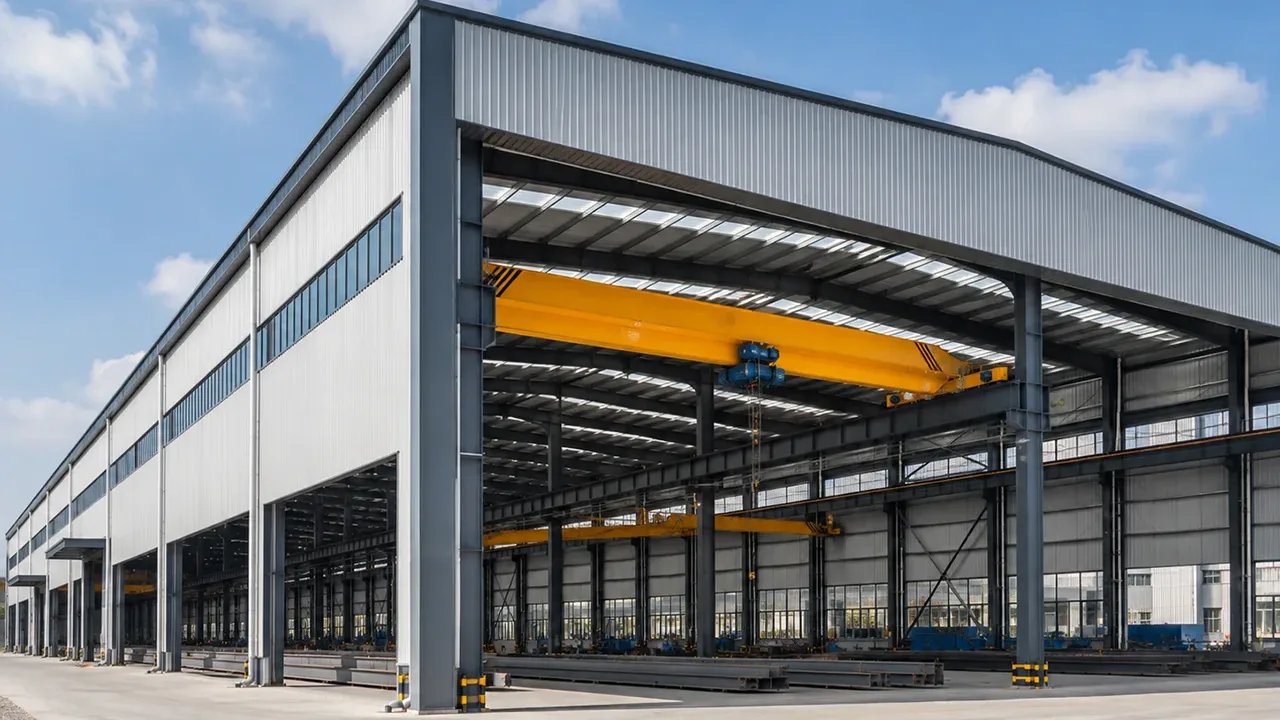
Truck Terminals and Cross-Dock Buildings in New Mexico
Cross-dock doors face each other across a floor with almost nothing in the way, because freight comes off one trailer and goes onto another in minutes, not days. A truck terminal is built for that rhythm. It is a long, narrow building with dock doors on both sides, a deep truck court, a place to park trailers and often a small office and driver room at one end. In New Mexico, it sits where the interstates meet.
We build terminals as pre-engineered rigid frame buildings, usually 100 to 200 feet wide at the long side and sometimes much longer, with columns kept out of the work area. The frame is not the hard part. The slab, the dock apron and the court decide whether trucks flow or jam.
We ask about turning radius, trailer count and peak hours before we draw anything. A terminal that works at 30 trucks a day and fails at 60 is a costly mistake, and it is better to find it on paper.
Court, apron and slab
A truck court for 53-foot trailers needs about 130 feet of depth for a straight-in dock, more if trucks must swing wide. The apron in front of each door takes the heaviest load on the site because trailers park and idle there, and concrete aprons last far longer than asphalt under standing wheels. Drive lanes and trailer stalls can be asphalt, and we price them separately.
Inside, the slab needs to be flat enough for forklifts and pallet jacks at speed, with joints that do not break edges. Dock levelers and seals need pits and framing in the slab pour. Drainage needs thought too, because a New Mexico monsoon can flood a flat court quickly. We slope the court away from the building and add inlets before the pavement goes in.
Where terminals sit
Interstate crossings and rail yards attract freight. I-25 and I-40 cross in central Albuquerque at the Big-I, and I-40 runs alongside the BNSF mainline through Gallup. The Union Pacific Santa Teresa intermodal terminal lists 74,000 feet of trackage that can expand to 145,000 feet and 1,266 trailer and container stalls that can grow to 4,380, in the same corridor as the Santa Teresa Port of Entry.
Those corridors pull in carriers who need a place to sort, stage and turn trucks. Smaller terminals also appear along I-40 and I-10, where regional carriers serve towns that are hours apart. Where freight is thin and distances long, a modest metal terminal with a dock, a yard and a shop can pay for itself. Our truck and fleet clients often add a maintenance bay.
What we build for a terminal
A full package covers the slab and dock pits, the primary frame, roof and wall panels, insulation as needed, overhead and dock doors, bumpers and seals, canopies over the doors and an office wing. Many carriers ask for a clear canopy over the dock face so drivers and freight stay dry, and we frame that into the building rather than adding it later.
We also build the small buildings around a terminal: a fuel island canopy, a wash bay, a drivers' lounge and a maintenance shop. The shop is often a manufacturing plant in miniature, with heavy slabs, floor drains and a bridge crane or hoist. Rigid frame erection for the shop and the dock can be done in one mobilization.
Traffic and worker safety
A terminal mixes trucks, forklifts and people. Striping, pedestrian paths, lighting and clear sight lines all reduce risk. Trailer restraints and dock locks prevent a trailer from creeping while it is loaded. Guardrails and bollards protect doors, columns and equipment.
During construction, the greatest hazard is existing traffic if the terminal is built next to a live yard. We fence the work, schedule crane picks in quiet hours and keep a clear route for emergency vehicles. We also plan stormwater controls early because a dirt court becomes a mud pit in the first heavy rain.
Where we travel for terminals
We build terminals along the interstates and at rail and border crossings. In Santa Teresa, the port and rail park draw cross-border freight. In Gallup, I-40 interchanges run from about exit 16 to exit 26, with freight trains and highway traffic side by side.
We are honest about distance. A terminal job in the far west or the northeast corner of the state means a crew staying near the site. We show lodging, travel time and material freight as lines in the bid. That makes the long-haul jobs easier to compare with ones near Albuquerque.
Where terminal money goes
The building is often a third of the total. Paving usually matches or beats it, since a deep truck court and heavy aprons cover more area than the roof does. Lighting, fencing, security cameras and a scale or fuel island follow. The dock equipment itself, levelers, seals and bumpers, adds up quickly across 40 or 60 doors.
Owners who also run storage can reduce risk by designing for a second use. A terminal framed with a clear 28 foot eave and a flat slab can become a distribution center if the freight pattern shifts, and many carriers lease part of the building to a shipper. We price the second-use features as options so you can decide with the numbers in hand.
Send us the truck count
Tell us your trailer count, your peak hours and your site. We will draw a dock, court and yard that fit the lot and price the building, the aprons and the pavement separately.
Common Questions
How wide should a cross-dock building be?
Width depends on freight volume and staging space between dock faces. Many terminals run 100 to 150 feet wide. Wider buildings add staging room at the cost of longer frame spans. We test your freight flow against a few widths.
Do I need concrete aprons?
You do at the dock faces. Trailers park and drop landing gear there, and asphalt will rut. Drive aisles and trailer stalls farther out can be asphalt or gravel in some cases, but heavy turning zones should be concrete.
Can a terminal also have a repair shop?
Yes. We attach shop bays to the dock building or build a separate shop with its own frame. Shops need floor drains, oil separators, ventilation and sometimes a crane, so they are priced apart from the dock.
What permits does a truck terminal need?
A building permit under the state commercial building code, a driveway or access permit, stormwater controls and often a fuel or hazardous material review if you fuel on site. Start the access permit early because it can take the longest.
How far is too far for a remote terminal site?
There is no fixed limit. The cost of travel and lodging rises with distance but is small next to land savings on some sites. We show those costs so you can compare. The more useful question is whether drivers will reach the terminal within their hours.